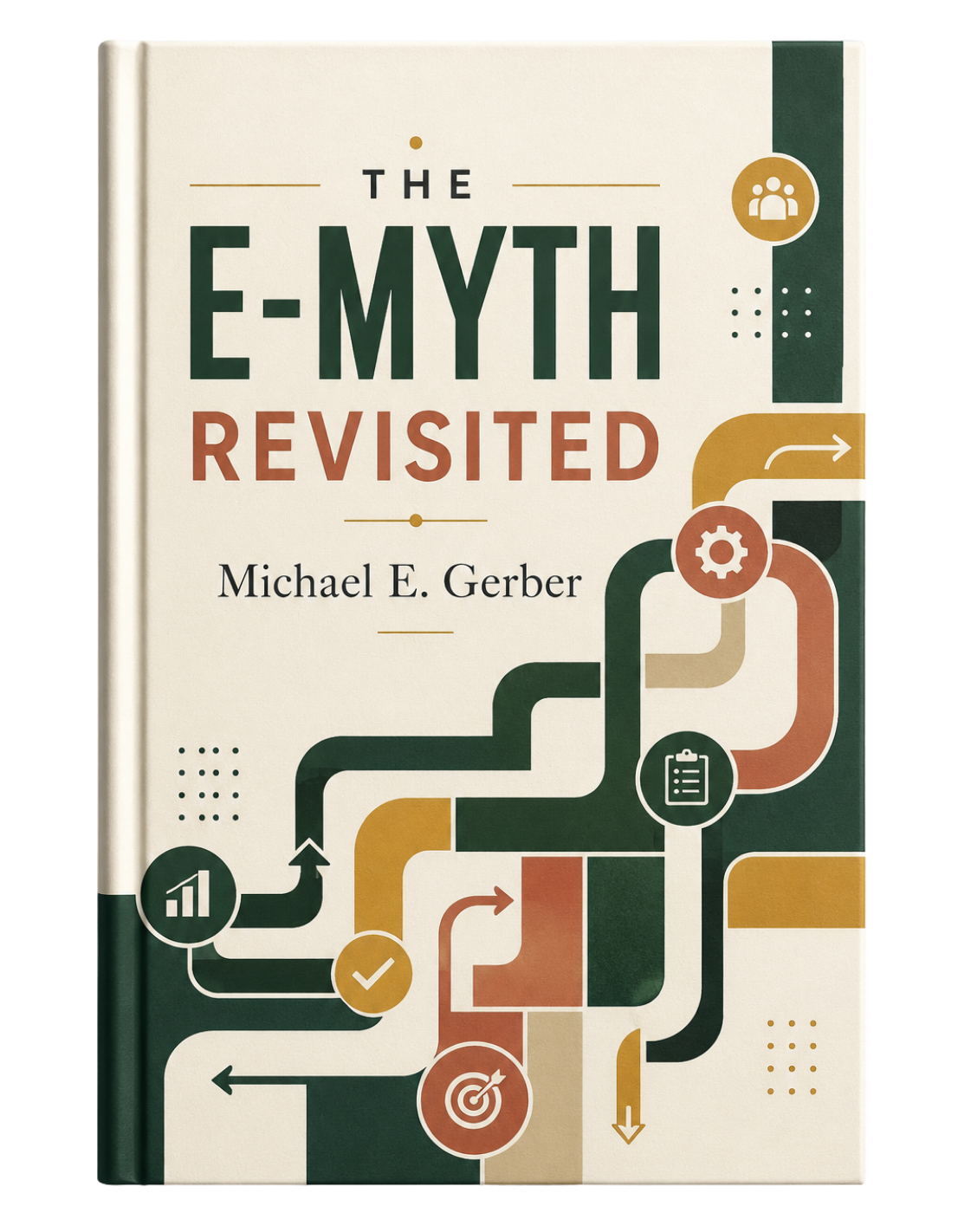
The E-Myth Revisited
by Michael E. Gerber · 1995
Why most small businesses depend too much on the owner, and how to build systems that allow the business to work without constant personal involvement.
Being good at technical work does not mean you automatically know how to run a business
- 01
Being good at technical work does not mean you automatically know how to run a business
- 02
Most small business owners get trapped working in the business
- 03
A successful business needs three roles: Entrepreneur, Manager, and Technician
- 04
Systems make a business consistent, scalable, and less dependent on one person
- 05
Work on your business, not just in your business
- 06
A business should be designed like a model that can be repeated
- 07
Growth requires process, people, standards, and clear structure
- 08
The goal is to build a business that serves the owner, team, and customers
The biggest business myth
The main idea of the book is simple but powerful: many people start a business because they are good at the technical work. A good doctor opens a clinic. A good baker opens a bakery. A good designer opens an agency. But…
The Entrepreneur, Manager, and Technician
Gerber explains that every business owner has three personalities inside them: the Entrepreneur, the Manager, and the Technician. The Entrepreneur dreams about the future. The Manager brings order and planning. The Techn…
Work on the business, not only in it
One of the most famous lessons from the book is that owners must learn to work on the business, not just in the business. Working in the business means doing daily tasks. Working on the business means designing systems,…
Your business needs systems
Gerber strongly believes that systems are what make a business scalable. Without systems, every day depends on memory, mood, individual effort, and personal supervision. A system is a clear way of doing something repeat…
The business should not depend only on you
Many small business owners start with freedom in mind, but slowly create a business that cannot function without them. They become the doctor, manager, problem-solver, marketer, trainer, coordinator, and decision-maker.…
Build a prototype, not just a workplace
Gerber encourages business owners to think of their business as a prototype. This means the business should be designed in a way that could be repeated, taught, and improved. The idea is not that every business must bec…
Maturity comes from structure
Gerber describes business growth in stages: infancy, adolescence, and maturity. In the early stage, the business and owner are almost the same. As the business grows, the owner starts needing help. But without structure,…
Chapter 1
The Entrepreneurial Myth
The book begins by challenging a common belief: that people who start businesses are naturally entrepreneurs. Gerber says many people actually start businesses because they are good at the technical work and assume that this will be enough.
This is the fatal assumption. A person may understand the work, but not the business that sells and delivers that work.
For example, a great dentist may not automatically know how to build a dental clinic brand. A good dermatologist may not automatically know how to manage patient flow, marketing, staff systems, or service experience.
The chapter teaches that business ownership requires a different mindset. You are not only the person doing the work. You are the person designing the machine that delivers the work.
— 1 —
Why most small businesses depend too much on the owner, and how to build systems that allow the business to work without constant personal involvement.
—
No reviews yet. Be the first.
Be the first to review
Share what stuck with you after reading.